Our inboxes have been flooded with messages full of anxiety like these. The uncertainty around recent U.S. visa policy changes has understandably created anxiety among international applicants. But amidst the noise, there has also been a great deal of confusion and misinterpretation. Let’s unpack what has actually changed, what hasn’t, and why this development could, counterintuitively, benefit students already in the U.S or planning to pursue higher education in the US in future.
The $100,000 H-1B Fee Explained
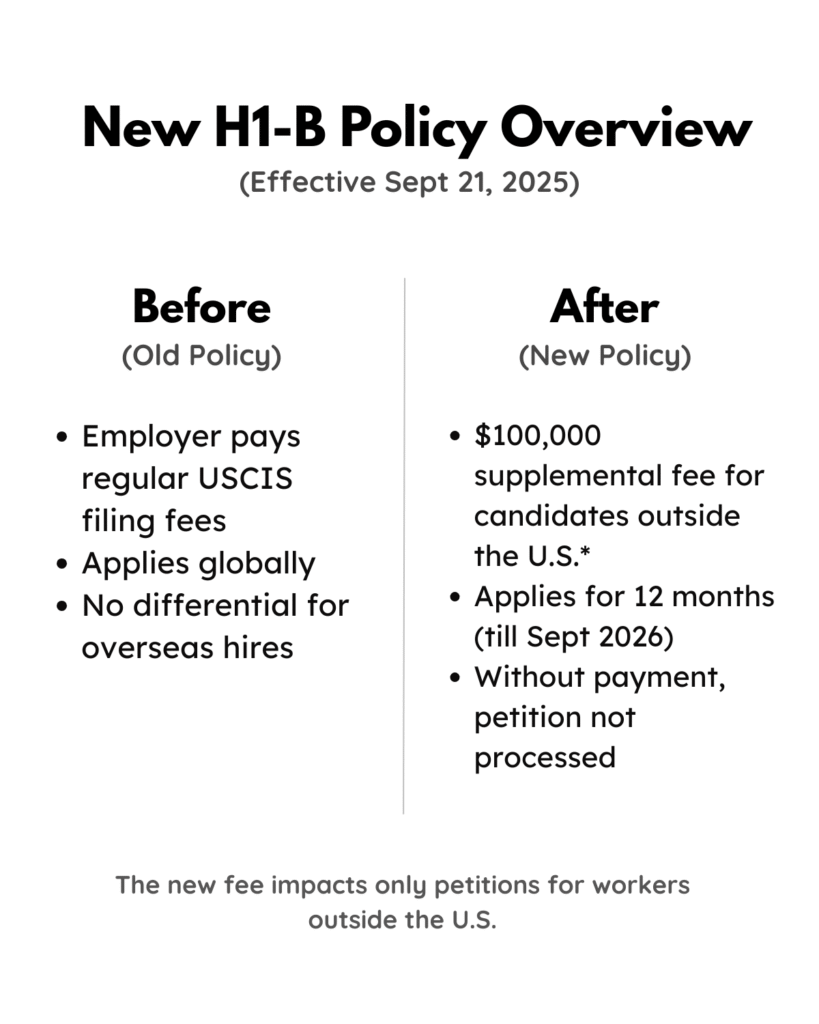
On September 19, 2025, the White House issued a Presidential Proclamation titled “Restriction on Entry of Certain Nonimmigrant Workers”.¹
Effective September 21, 2025, any new H-1B petition filed for a candidate outside the U.S. must include a $100,000 supplemental fee.
If the fee isn’t paid, the petition will not be processed, effectively making it prohibitively expensive for most employers to hire international talent directly from abroad.
The proclamation currently applies for 12 months, through September 20, 2026, unless extended by a subsequent order.
What’s Not Affected (for Now)
Here’s the key point many have missed:
The new $100,000 fee only applies to H-1B petitions filed for individuals outside the United States.
This means:
- Students currently in the U.S. on F-1, OPT, or STEM OPT who later apply for an H-1B change of status are not subject to this fee.
- Existing H-1B holders, as well as renewals or extensions, are not impacted
In other words, this policy raises the cost barrier for companies hiring new employees directly from overseas, but it does not affect students or professionals already living and working in the U.S. under F-1/OPT/STEM OPT status
Why the 2025 H-1B Visa Changes Might Benefit International Students
For students considering an MBA or master’s program in the U.S., this policy may actually improve their long-term employment odds.
Here’s why:
When it becomes substantially more expensive for companies to hire international workers from abroad, employers are more likely to prioritize candidates already in the U.S. who can transition from F-1/OPT to H-1B without paying the new fee.
This shift effectively reduces competition in the H-1B lottery for those already in the U.S.
The Numbers: H-1B Visa Statistics from FY2024
According to official USCIS data,² of all H-1B petitions approved in FY2024:³
| Petition Type | Description | Approx. Number | Share of Total |
| Initial Employment | New petitions for first-time H-1B holders | 120,000 | ≈30% |
| Change of Status (inside U.S.) | F-1/OPT to H-1B transitions | 80,000 | ≈19.8% |
| Consular Processing (outside U.S.) | New petitions from abroad | 43,000 | ≈10.5% |
Currently, the odds of approval are approximately:
- 1 in 5 (20%) for Change of Status (inside the U.S.), and
- 1 in 10 (10%) for Consular Processing (outside the U.S.).
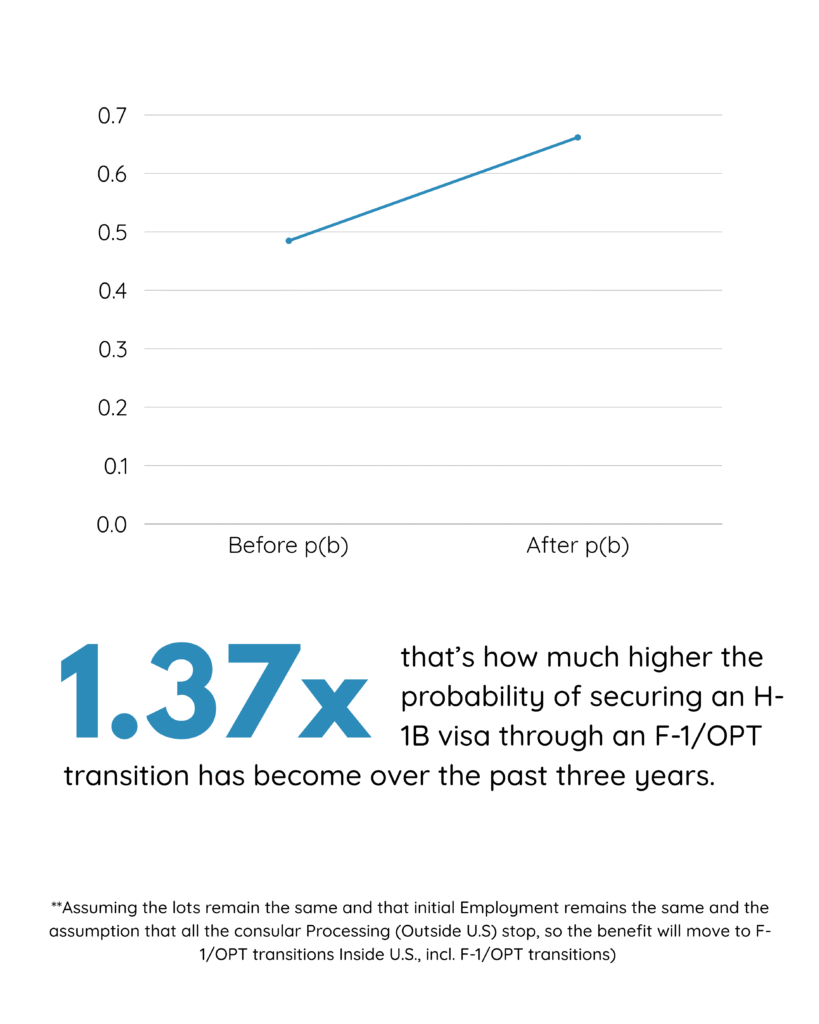
If most Consular Processing petitions stop because of the new $100K fee, and those visa slots effectively shift to Change of Status applicants, the odds for F-1/OPT holders could improve to roughly 1 in 3 (33%).
That means that over a standard three-year OPT/STEM OPT period, the cumulative probability of securing an H-1B could rise from about 48% (≈1 in 2) to roughly 66% (≈2 in 3), a significant increase in favor of those already in the U.S.
The Bottom Line on H-1B Visa Fee Impact for 2025
This new policy doesn’t close doors for international students, it simply changes which doors are easier to open.
For candidates already in the U.S. or planning to study there, the cost barrier shifts in your favor. Employers’ incentives now lean toward hiring from within, potentially improving both your H-1B odds and your long-term career prospects in the U.S.
If you were reconsidering U.S. programs because of perceived visa risk, it might be time to revisit that decision with a clearer picture.
References
- White House Presidential Proclamation – Restriction on Entry of Certain Nonimmigrant Workers, September 19, 2025
- USCIS Newsroom: H-1B FAQ
- USCIS FY2024 H-1B Petitions Data (PDF)
Appendix: Calculations and Assumptions
- H-1B Approval Distribution (Base Data)
- Total New Petitions: ~400K
- Inside U.S. (Change of Status): 80K (19.8%)
- Outside U.S. (Consular): 43K (10.5%)
- Current Odds (Simplified Model)
If ~400K petitions compete for ~200K annual approvals:
- Inside U.S. odds ≈ 20% (1 in 5)
- Outside U.S. odds ≈ 10% (1 in 10)
- Post-Policy Scenario
If consular petitions (~43K) are largely suppressed and their slots reallocated:
- Inside U.S. pool = 80K petitions
- Additional 43K approvals distributed across this smaller base
- New odds ≈ (80K approvals / 240K petitions) ≈ 33% (1 in 3)
- Three-Year Cumulative Probability
For three consecutive annual attempts:
- Current: 1 – (1 – 0.20)³ = 48%
- New: 1 – (1 – 0.33)³ = 66%
Hence, F-1/OPT students’ three-year cumulative chance of success could rise from ~48% to ~66%.
Disclaimer
This article represents our interpretation of recent policy developments based on publicly available information. The H-1B landscape remains a grey area with evolving dynamics, and government guidance may change as further clarifications are issued.
This content is provided for general informational purposes only and should not be construed as legal or immigration advice. Readers are encouraged to consult an immigration attorney or official government sources for personalised guidance.